How to Verify AI Output Before You Trust It (2026)
In 2023, a New York attorney was sanctioned $5,000 after submitting a legal brief with six court cases that didn’t exist — ChatGPT had invented them, complete with fake case numbers, and when the attorney asked the AI whether the cases were real, it confidently said yes. That was treated as a one-off embarrassment at the time. By early 2026, a public tracker maintained by a legal researcher had documented well over a thousand similar incidents worldwide, and in February 2026, a Nebraska attorney was suspended from practicing law entirely after filing a brief in which 57 of 63 citations turned out to be defective. The penalties didn’t just grow. The pattern repeated across the profession, at scale, in public.
This isn’t a story about lawyers being careless. It’s a story about what happens when fluent, confident, well-formatted AI output meets a profession that didn’t yet have a habit of checking it. Every profession is in exactly that position right now. This guide is the habit.
What Hallucination Actually Is (and Isn’t)
It’s Not “The AI Lying” — It’s a Side Effect of How These Models Work
A hallucination isn’t the AI deciding to deceive you. These models are trained in a way that rewards producing a plausible-sounding answer over admitting uncertainty — not unlike a multiple-choice test where leaving a blank guarantees zero points but a guess has a chance of being right. The model has learned, in effect, that guessing beats abstaining. That’s why a hallucinated answer reads with exactly the same fluency and confidence as a correct one — there’s no built-in “I’m not sure” signal you can rely on.
Also check our article on How to Use AI at Work: The Complete Beginner’s Guide(2026) to have a better understanding
The Counter-Intuitive Finding: Smarter Models Can Hallucinate More, Not Less
Here’s something that runs against most people’s intuition: independent benchmark testing in 2026 found that some newer “reasoning” models — the ones built for deeper, multi-step analysis — hallucinated on open-domain factual questions at meaningfully higher rates than their simpler predecessors. Researchers have started calling this the “reasoning tax.” The takeaway isn’t that reasoning models are worse tools — they’re often better at genuine reasoning tasks — it’s that “this is the newest, most advanced model” is not a substitute for verification. If anything, treat a model’s confidence and its sophistication as unrelated to its accuracy on any single claim.
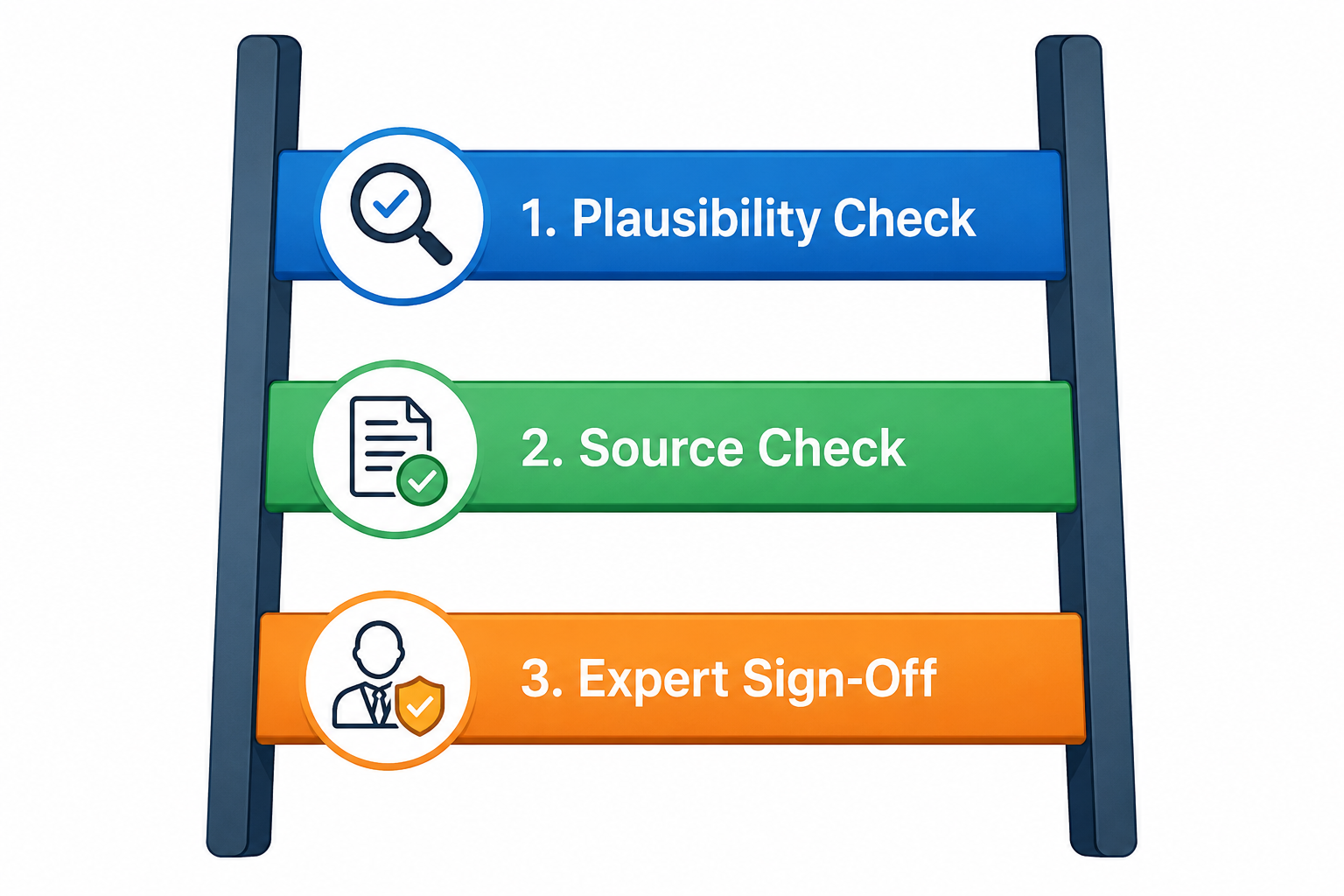
The Verification Ladder — Our Framework
Not every AI-generated claim deserves the same amount of scrutiny — treating a casual internal note and a client-facing report identically wastes time on one and risks real damage on the other. The Verification Ladder gives you three levels of effort, and a simple rule for which one a given claim needs.
Rung 1: The Plausibility Check
A fast, always-do-this gut check: does this pass basic sanity? Is the number in a reasonable range, does the name sound like it could be real, is it internally consistent with everything else in the document? This takes seconds and catches the most obviously broken outputs.
Rung 2: The Source Check
Can you independently confirm this specific claim outside the AI tool itself — a quick search, a database lookup, asking a colleague who’d know? This is where most genuinely important claims should land: not a full investigation, but a real, independent check.
Rung 3: Expert Sign-Off
A qualified human must review and approve this before it’s used — not just spot-checked, but actually verified by someone with the standing to catch what an outside search can’t. This is non-negotiable for anything touching legal, medical, financial, or safety-critical decisions.
The Rule for How High to Climb
Ask two questions about the claim in front of you: How costly would it be if this is wrong? And how easily can it actually be checked? High cost, easily checked → climb to Rung 2 and actually do it, there’s no excuse not to. High cost, hard to independently verify → that’s Rung 3, full stop. Low cost, easily checked → Rung 1 is often genuinely enough.
The Trap: Unverifiable but Confident
This is the pattern most people miss entirely: when a claim sounds authoritative but you realize you have no real way to check it — an obscure statistic with no clear source, a technical detail outside your expertise — the right response isn’t to relax because it “sounds credible.” It’s the opposite. Unverifiable-and-confident is exactly the combination that should push a claim to Rung 3, or push you to leave it out of the final work entirely if no one can actually verify it.
The Step-by-Step Verification Workflow
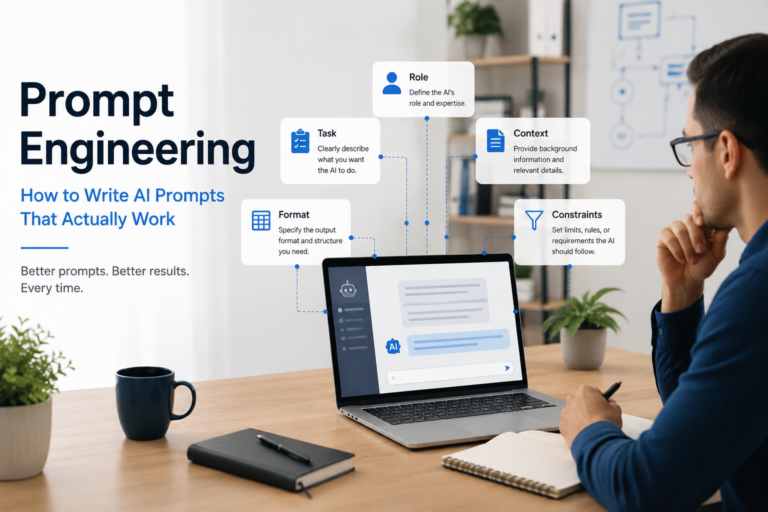
- Read the entire output before acting on any of it (Check out our article on Prompt Engineering for Professionals). Skimming is how a confidently wrong sentence buried in an otherwise-solid paragraph slips through.
- Identify every checkable claim — names, numbers, dates, citations, direct quotes, technical specifications.
- Climb the Verification Ladder for each one, using the rule above.
- For anything landing on Rung 2 or 3, verify outside the AI tool — a search engine, a primary source, a database, or a colleague with direct knowledge.
- If a second AI tool gives you a materially different answer to the same question, treat that disagreement itself as a Rung 3 signal — don’t just pick whichever answer you liked better. (Check our Article on ChatGPT vs Claude vs Gemini vs Microsoft Copilot)
- Sign off explicitly. Before anything ships, know that you — not the AI — are accountable for what’s in it.
Real Hallucinations, By Type
Fabricated Citations and Sources
The most thoroughly documented category, thanks to court records: AI tools inventing case law, complete with realistic-sounding case numbers and quotes, formatted exactly like a real citation. The same failure mode shows up in academic and business research — a fabricated study name, a DOI that goes nowhere, an author who didn’t write what’s attributed to them.
Invented Statistics
A precise-sounding number — “73% of companies report…” — carries no more evidentiary weight than a rounded guess unless you can trace it to an actual source. Precision is a formatting choice, not evidence of accuracy.
Confidently Wrong Facts and Dates
Straightforward factual errors — a wrong date, a misattributed quote, a detail that’s simply incorrect — delivered with identical fluency to the surrounding correct information.
Hallucinated Code Libraries and Packages
AI coding assistants have been documented recommending software packages or library functions that don’t actually exist, formatted exactly like real ones — a problem serious enough that it’s been given its own name in developer security circles, since a plausible-sounding fake package name is also a real security risk if someone registers that name maliciously.
Industry Examples: Where This Actually Bites
(These are illustrative examples of a well-documented pattern of AI failure, offered as general awareness — not profession-specific technical, legal, financial, or medical guidance. Anyone in a regulated field should apply their own professional judgment and consult a qualified expert in that field.)
Business
A hallucinated regulatory citation in an internal memo never has to survive a courtroom to cause damage — it can steer a leadership decision in the wrong direction just as easily, with no one ever checking it because it never left the building.
Engineering
An AI tool confidently citing a specific standard clause, safety factor, or material property that sounds precise but doesn’t match the actual referenced code — exactly the kind of error our own Verify Twice quadrant exists to catch, because the task (looking up a spec) feels simple even when the stakes are high.
Finance
A model-generated figure — a growth rate, a market size, a comparable transaction value — that reads as precisely researched but traces back to no real source, quietly built into a spreadsheet that then informs a real financial decision.
HR
A confidently stated but incorrect claim about employment law or a specific regulation, drafted into a policy document that an employee later relies on — the gap between “sounds like standard HR language” and “is actually correct for this jurisdiction” is exactly where this goes wrong.
Marketing
A fabricated statistic or survey citation dropped into content marketing because it made the copy more persuasive — a real reputational risk once a reader or competitor traces the “source” and finds nothing there.
Software Development
A hallucinated package name or function that doesn’t exist, recommended with complete confidence and syntactically perfect formatting — costly in wasted debugging time at best, a security exposure at worst if the fake package name gets registered by someone else.
Healthcare
Independent 2026 hazard analysis has flagged AI chatbot misuse as a leading health-technology risk, and benchmark testing across thousands of medical question-answer pairs found that even leading models caught only a fraction of subtle false health statements. This is a field where Rung 3 — qualified human sign-off — isn’t a suggestion, it’s the baseline.
Education
A fabricated citation or source slipped into a lesson plan, reading list, or student research aid — a risk that compounds because the whole point of the material is to be trusted and passed along to students who have even less ability to independently check it.
The Verification Checklist
Run this before anything AI-assisted goes out the door:
- Have I read the entire output, not just skimmed it?
- Have I identified every checkable claim — names, numbers, dates, citations, quotes?
- Have I climbed the Verification Ladder for each one based on consequence and checkability?
- Have I verified anything at Rung 2 or 3 outside the AI tool itself?
- Have I treated any “unverifiable but confident” claim with extra suspicion, not less?
- Am I willing to put my name on this exact content, as written?
Common Mistakes People Make When Trusting AI
- Mistaking fluency for accuracy. A confidently written sentence is not evidence of anything except that the model is good at writing confidently.
- Assuming a newer or more advanced model needs less verification. As covered above, that’s not reliably true — and can be backwards.
- Trusting a claim more because you can’t easily check it. This is the exact opposite of the correct instinct — see “The Trap” above.
- Asking the AI to verify itself and treating the answer as independent confirmation. It isn’t. Genuine verification happens outside the tool that made the claim.
- Verifying once and assuming a similar prompt next time will produce an equally reliable answer. Each output is a new roll, not a guarantee.
When AI Should Never Be Trusted Without Human Verification
This extends directly from the “Keep It Human” principle in our beginner’s guide. Full stop, no exceptions: legal filings and citations, medical or health-related claims, financial figures that inform a real decision, safety-critical specifications or calculations, and anything where the underlying source can’t be independently traced at all. In every one of these, AI can help you prepare and draft — it should never be the last check before something ships.
Where to Go From Here
This completes our core Fundamentals series: if you haven’t already, start with the beginner’s guide for the Delegation Matrix, compare tools in our ChatGPT vs Claude vs Gemini vs Copilot guide, and sharpen your prompts with our prompt engineering guide — all four pieces work as one connected system, and this is the piece that makes the other three safe to actually use.
Frequently Asked Questions
What is the Verification Ladder? A three-rung framework — Plausibility Check, Source Check, Expert Sign-Off — for deciding how much verification effort a specific AI-generated claim actually needs, based on how costly it would be if wrong and how easily it can be checked.
How common are AI hallucinations really? Rates vary widely by task and model — independent 2026 testing across several frontier models found hallucination rates ranging from roughly 3% to 19% depending on the specific task, and legal-research-specific testing has found rates far higher on certain query types. The variation itself is the lesson: don’t assume a flat, low “it’s basically fine now” rate applies to your specific use case.
Does using a more advanced or newer AI model mean I need to verify less? Not reliably, and possibly the opposite — see the “reasoning tax” finding above. Verification effort should be driven by the claim’s consequence and checkability, not by which model produced it.
Can I just ask the AI to double-check its own answer? It’s worth trying — sometimes a follow-up question surfaces the model’s own uncertainty — but that’s a first-pass signal, not independent verification. Genuine verification happens outside the tool that made the original claim.
What’s the single biggest verification mistake professionals make? Treating a claim as more trustworthy because it can’t easily be checked, when the opposite instinct is correct — an unverifiable but confident-sounding claim deserves more scrutiny, not less.

One Comment