Can You Actually Make Money With AI? What Works, What’s Hype, and What the Numbers Really Look Like (2026)

Search “make money with AI” and you’ll find channels claiming $50,000 a month from faceless YouTube videos, “AI music” accounts claiming six figures, and tools boasting a 0% AI-detection rate as a selling point. Some of this space is real. Most of the loudest claims in it are not independently verifiable, and a few are structured exactly like the get-rich-quick schemes that predate AI by decades. This guide applies the same standard we apply to every claim on this site: if a number can’t be traced to something real, it gets labeled as unverified, not repeated as fact.
1. Can You Really Make Money With AI?
Yes — but the honest version looks less like a windfall and more like leverage on a skill you already have. The most credible, repeatedly-corroborated pattern across every source we reviewed is this: AI amplifies existing expertise rather than replacing the need for it. A freelancer with real domain knowledge who adds AI to their workflow can realistically see a 20–50% increase in output and income. Someone with no underlying skill, expertise, or client relationships gets none of that — AI has nothing to amplify.
This is worth sitting with, because it’s the opposite of how the topic usually gets sold. Most “make money with AI” content implies the AI itself is the asset. The more defensible reading of the evidence is that your existing skill is still the asset — AI is the multiplier on it, and multiplying zero still gets you zero.
Time Investment Comparison
| Business model | Time to first dollar | Time to meaningful income |
|---|---|---|
| Freelancing with AI | Days to weeks | Weeks to a few months |
| Selling prompts/templates | Days to weeks | Months, if volume builds |
| AI chatbot/service building | 1–4 weeks | 2–4 months for repeat clients |
| AI consulting | 4–16 weeks (slowest first dollar of the faster-moving models) | 6+ months, portfolio-dependent |
| Automation agency | 4–12 weeks | 3–6 months for retainer base |
| AI content/blogging | Months (traffic-dependent) | 6–12+ months |
| Affiliate marketing | Weeks to months | 6–12+ months, traffic-dependent |
| AI YouTube channels | 2–4 months (monetization thresholds alone) | 12+ months for most creators |
| AI newsletters | Weeks to post; months to monetize | 6–12+ months, list-size dependent |
| AI design services | Days to weeks | Weeks to a few months |
| Coding with AI | Days to weeks | Weeks to a few months |
| AI-powered SaaS | Months | 12–24+ months |
| AI education | Weeks to launch; months to earn meaningfully | 6–12+ months, audience-dependent |
The pattern across this table is consistent with the income-range table above: models requiring an audience (content, YouTube, newsletters, education) are slow regardless of how AI-accelerated the content itself is, because audience-building was never the part AI sped up.
2. The Biggest Myths
- “AI generates passive income while you sleep.” Every credible source we reviewed contradicts this directly — AI reduces the effort required to build an income stream, it doesn’t eliminate the effort.
- “You just need to know prompt engineering.” Generalist prompting skill has compressed in value as more people acquired it. Domain expertise, not prompting alone, is what still commands premium rates.
- “Any AI tool reselling business works.” Positioning yourself as a middleman between an AI platform and customers, with no added value, is explicitly identified as a low-or-no-earnings pattern by multiple sources.
- “$50K/month from a faceless AI channel is typical.” It’s a reported outlier from a small number of creators, not a realistic median outcome — treat any specific large number attached to a “faceless channel” claim with real skepticism.
- “AI will replace your job, so build an AI business instead.” The realistic story is narrower: AI amplifies people who already have a marketable skill; it doesn’t manufacture one from nothing.
3. What the 2026 Market Actually Looks Like
Client expectations have shifted. Using AI is now a baseline assumption, not a premium differentiator — clients pay for output quality and speed, not for the fact that AI was involved at all. This has compressed rates for generalist AI-assisted writers, while specialists serving regulated or complex industries (finance, legal, healthcare, technical fields) have held or grown their rates, because domain expertise is harder to replicate with AI alone than generic content is. The clearest divide in the market right now isn’t “uses AI” vs. “doesn’t” — it’s “has real expertise AI amplifies” vs. “has only AI and no differentiation.”
4. Business Models That Genuinely Work
The 14 models covered below span a wide range of realistic outcomes. None of them are passive, and all of them require real time investment before producing income.
5. Freelancing With AI
Use AI to draft, research, and speed up delivery on a skill you already sell — writing, design, development, analysis. Realistic income: existing freelance rates plus a 20–50% capacity increase, translating to meaningful but not transformational additional income for an established freelancer. Real example: a content agency that layered AI into its writing workflow increased output several-fold and moved from small per-article fees to multi-thousand-dollar monthly retainers for the same client relationships — the AI accelerated delivery, but the agency’s existing client relationships and editorial judgment were what the retainer was actually paying for. Who this doesn’t work for: anyone using freelancing as their entry point into a skill they don’t yet have — the research is consistent that AI amplifies an existing baseline rather than substituting for one that isn’t there yet.
6. Selling AI Services (Chatbots and Custom Tools)
Building and maintaining AI chatbots or simple automations for small businesses that lack in-house technical capacity. Realistic income: a few hundred to a couple thousand dollars per project, plus optional monthly retainers for upkeep. Startup cost: low — mainly time to learn one no-code platform well. Real example: small businesses in e-commerce, dental and medical practices, and professional services are the most frequently cited buyers, largely because they have real customer-service volume but no internal technical team. Where the real value sits: not in the initial build, which is increasingly commoditized, but in the ongoing maintenance relationship — a chatbot that goes stale within a few months without updates is a common complaint, which is exactly why the retainer model tends to outperform one-off project fees over time.
7. AI Consulting
Auditing a business’s existing workflows and recommending where AI genuinely helps, then supporting implementation. Realistic income: meaningfully higher hourly rates than generic freelancing, but the bar for credibility has risen — by 2026, most business decision-makers have already tried AI tools themselves, so consultants without demonstrable implementation case studies struggle to command premium fees. Honest risk: “generic AI consultant” with no specific track record is explicitly named across sources as one of the weakest, most oversaturated positions in this entire space. What actually differentiates a viable consulting practice: a specific, named specialization — “AI implementation for coaching institutes” earns more credibility and higher rates than “AI consultant” with no stated focus, precisely because clients can evaluate a narrow claim against their own situation far more easily than a broad one.
8. AI Content Businesses
Publishing content — blogs, niche sites — using AI to accelerate research and drafting, monetized through ads and affiliate links. Realistic income: display ad networks pay roughly $15–$50 per 1,000 visits once a site qualifies for a premium ad network; meaningful income requires real traffic volume, which takes months to build regardless of how fast the content itself is produced. Real risk: search engines actively penalize low-quality, mass-produced AI content — the sources agreeing most strongly on any single point in this entire space is that genuine editorial judgment and real expertise, not just AI-generated volume, is what survives. Practical note: a site publishing 50–200 articles in 90 days is technically achievable with AI assistance, but publishing speed and search ranking are different problems — a fast-launched site with thin, undifferentiated content still competes poorly against slower, more carefully edited competitors.
9. AI Automation Agencies
Building custom workflow automations for businesses, connecting tools like Zapier, Make, or n8n to AI models. Realistic income: reported per-project rates in the low thousands, plus monthly maintenance retainers in the hundreds. Honest caveat: these figures come from community-reported forum discussions, not audited data — treat them as directional, not guaranteed. Real example: ties directly to the practical Rung 1/2 automation skills covered in our automation guide — this business model is essentially that skill, sold as a service. What actually differentiates providers: speed of delivery and integration breadth matter more to clients in 2026 than simply demonstrating that automation is possible at all — most prospective clients have already accepted that automation works and are comparing providers on execution, not concept.
10. AI-Powered SaaS
Building a software product with AI capability built in, for a specific niche or vertical. Realistic income: highest ceiling of any model on this list, but also the longest timeline — realistic paths to meaningful recurring revenue are commonly described in terms of 12–24 months for a solo, technically capable builder, not weeks. Skill requirement: real technical development ability, not just prompting skill. Where this tends to work: narrow, unglamorous, industry-specific problems — invoice processing for a specific accounting niche, screening tools for a specific hiring vertical — rather than broad, general-purpose tools competing directly with well-funded incumbents.
11. AI Education
Teaching others how to use AI tools — courses, YouTube content, written guides. Realistic income: highly variable, driven by audience-building skill as much as AI knowledge itself. Honest risk: this is also the most crowded category in the entire “make money with AI” space — a meaningful share of all “make money with AI” content is itself AI-education content selling a course, which is worth noticing as a pattern in its own right. A useful gut-check before entering this model: if your plan is to teach a skill you haven’t yet demonstrated earning real money from directly, that’s a strong signal to build the underlying track record first — the most credible AI educators in this space are the ones who can point to real client work or a real product, not just the teaching content itself.
12. Affiliate Marketing With AI
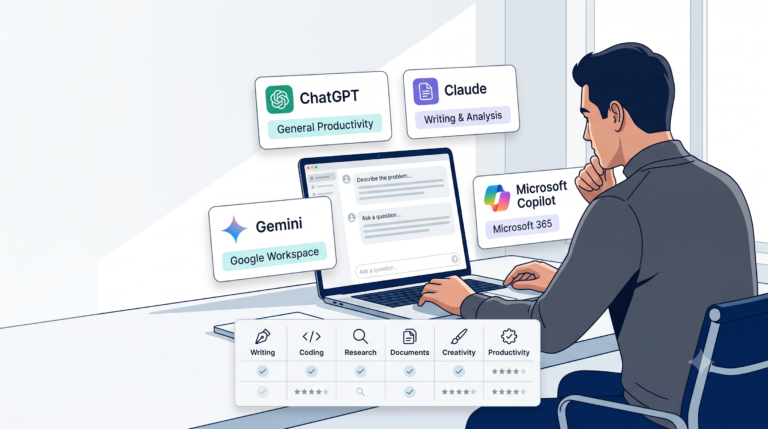
Publishing content that recommends AI tools, earning commission on signups. Realistic income: AI tools carry some of the highest recurring commission rates in SaaS affiliate marketing, commonly cited in the 20–45% range — but commission rate alone doesn’t guarantee income without real traffic and real trust, which takes time to build. Consistency with our own standards: exactly the kind of content our own best AI tools guide and editorial policy are built to do honestly, with clear disclosure, rather than letting commission size dictate what gets recommended.
13. AI YouTube Channels
“Faceless” channels using AI for scripts, voiceover, and video assembly. Realistic income: a small number of well-documented success cases exist, but the widely repeated large figures are self-reported and unverified. Honest timeline: monetization thresholds alone (subscriber and watch-hour minimums) typically take several months to reach even with consistent output, before any revenue begins.
14. AI Newsletters
Building an email audience around a specific topic, monetized through sponsorships or paid subscriptions. Realistic income: driven primarily by list size and niche specificity, not by AI itself — AI mainly accelerates the writing and research, not the audience-building, which remains the slow part.
15. Selling Prompts
Packaging and selling tested, reusable prompts for a specific task or industry. Realistic income: generally low per-unit price and modest volume — this is one of the lower-ceiling models on this list, better suited as a small supplementary income stream or a lead magnet (as our own 100 ChatGPT Prompts library functions) than a standalone business.
16. Selling Templates
Similar to prompts, but packaged as complete documents, spreadsheets, or workflows rather than raw prompt text. Realistic income: modest per-unit price, meaningfully improved by bundling with real expertise (a genuine, tested business template) rather than a generic AI-generated document with no differentiation.
17. AI Design Services
Using AI image and design tools to deliver graphics, social content, or basic branding work for clients. Realistic income: comparable to entry-level freelance design rates, with AI mainly compressing delivery time rather than raising the price ceiling — clients are paying for a finished, on-brand result, not for the tool used to get there.
18. Coding With AI
Freelance or contract software development, accelerated by AI coding assistants. Realistic income: among the higher hourly-rate models on this list, since real development skill remains the scarce, hard-to-fake input — AI speeds up the work, similar to freelancing generally, without replacing the underlying expertise a client is actually paying for.
19. Businesses AI Cannot Easily Replace
The clearest pattern across every credible source: trust-based, judgment-heavy, relationship-driven work remains the hardest to replicate with AI alone — hands-on services, high-stakes advisory relationships, anything where a client is paying specifically for a named, accountable human. This is the same “Keep It Human” principle from our beginner’s guide, applied to business models rather than individual tasks: the further a service sits from repeatable, low-judgment work, the more durable it is against AI-driven commoditization.
20. Income Ranges for Different AI Businesses
| Business model | Realistic income range | Confidence level |
|---|---|---|
| Freelancing with AI | +20–50% on existing freelance income | Reasonably well corroborated |
| AI chatbot/service building | A few hundred–$2,000+ per project | Reasonably well corroborated |
| AI consulting | Meaningfully above generic freelance rates, with a rising credibility bar | Directionally supported |
| AI content/blogging | Ad/affiliate income scaling slowly with real traffic | Well corroborated, slow timeline |
| Automation agency | Low thousands per project, modest monthly retainers | Community-reported, not audited |
| AI-powered SaaS | Highest ceiling, longest timeline (12–24+ months) | Directionally supported |
| AI education/courses | Highly variable, audience-dependent | Weakly supported, oversaturated |
| Affiliate marketing | High commission rates, slow-building traffic-dependent income | Well corroborated, slow timeline |
| AI YouTube channels | A few well-documented outliers; typical results far lower | Largely unverified at the high end |
| AI newsletters | Driven by list size, not AI itself | Directionally supported |
| Selling prompts | Low per-unit, modest volume | Low ceiling, well corroborated |
| Selling templates | Low-to-modest, improved by real expertise | Low-to-modest ceiling |
| AI design services | Entry-to-mid freelance design rates | Reasonably well corroborated |
| Coding with AI | Among the higher hourly rates on this list | Reasonably well corroborated |
21. Startup Costs
| Cost tier | Business models |
|---|---|
| Near $0 | Freelancing (existing skill), selling prompts, selling templates |
| Under $100/month | AI chatbot services, newsletters, content/blogging, affiliate marketing |
| $100–$500/month | Automation agency (tool subscriptions), AI design services |
| Meaningful upfront + ongoing | AI-powered SaaS (development time or contractor cost), AI education (production costs for courses/video) |
22. Skills Required
| Skill | Most relevant models |
|---|---|
| Existing domain expertise | Freelancing, consulting, coding, design |
| No-code tool comfort (Zapier, Make, n8n) | Automation agency, chatbot services |
| Writing and editorial judgment | Content/blogging, newsletters, affiliate marketing |
| Audience-building / marketing | YouTube channels, newsletters, education |
| Real technical development ability | AI-powered SaaS |
| Sales and positioning ability | Consulting, automation agency |
The AI Income Reality Check — Our Framework
A short diagnostic before committing time to any specific model:
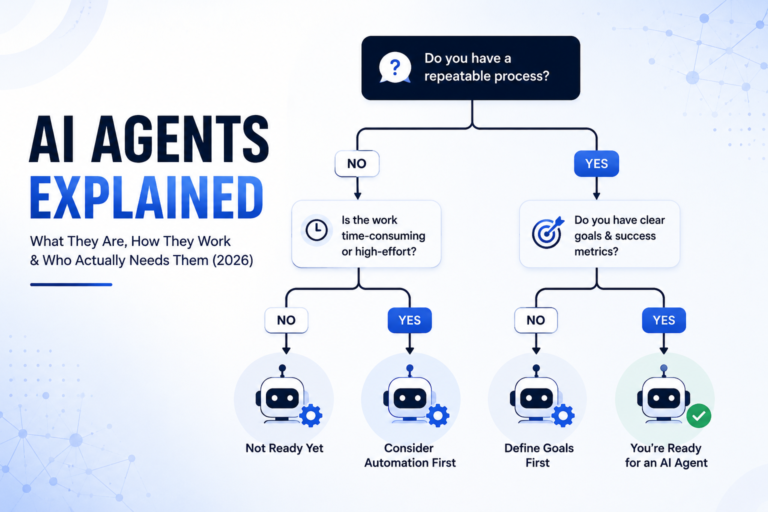
START: Do you already have real expertise in something
       (writing, design, code, a specific industry)?
│
├─ NO → Start with freelancing-adjacent, low-cost models
│        (selling prompts/templates) to learn the market
│        before investing in anything bigger.
│
└─ YES → continue

   Do you have more available TIME or more available CAPITAL?
   │
   ├─ More TIME → Content, newsletters, affiliate marketing,
   │              or AI education — slow-building, low-cost models.
   │
   └─ More CAPITAL → Automation agency, AI design services,
                      or (with real technical skill) AI-powered SaaS.

   How much RISK are you comfortable carrying before first income?
   │
   ├─ LOW → Freelancing with AI (fastest, most predictable path)
   │
   └─ HIGHER → Consulting or SaaS (slower first dollar,
                higher ceiling if it works)
Risk vs. Reward Matrix
| Lower reward ceiling | Higher reward ceiling | |
|---|---|---|
| Lower risk | Selling prompts/templates, freelancing with existing skill | Affiliate marketing, AI chatbot services |
| Higher risk | AI YouTube channels (crowded, outlier-driven) | AI-powered SaaS, AI consulting (credibility-dependent) |
Practical Roadmaps: Two Real Starting Points
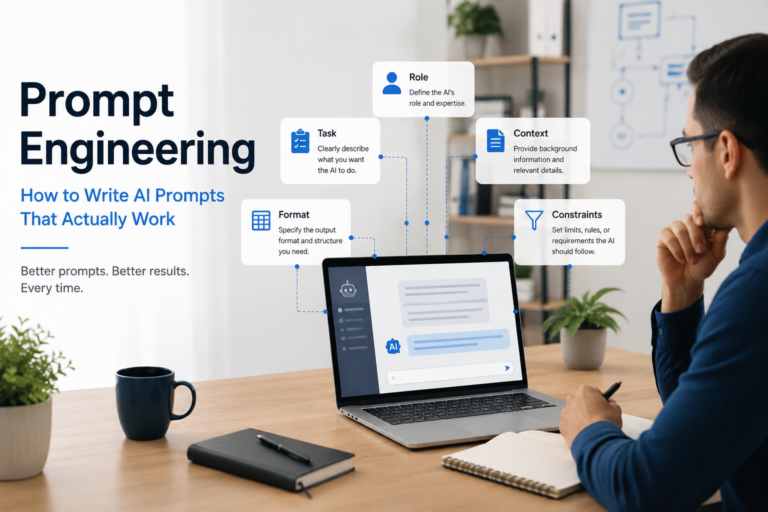
If you want the fastest realistic path (Freelancing with AI): Weeks 1–2, audit your existing service offering and rebuild your workflow around AI-assisted drafting or research using the Four-Layer Prompt from our prompt engineering guide. Weeks 3–4, quote existing or prospective clients at your normal rate while quietly delivering faster, banking the time savings rather than immediately discounting. Months 2–3, use the freed-up capacity to take on additional clients rather than working the same hours for the same total output. The AI accelerates delivery; the business growth still comes from your own outreach and reputation, not from the tool.
If you want the highest ceiling and can tolerate a slower start (AI-powered SaaS): Months 1–2, validate a specific, narrow problem in an industry you understand well enough to know it’s real — the “Indian small accountants” and “coaching institutes” examples from the research above are useful precisely because they’re narrow, not broad. Months 3–6, build a minimal working version, ideally with real technical skill rather than relying entirely on AI-generated code you can’t maintain yourself. Months 6–12+, get a small number of paying users before scaling anything — the realistic timeline to meaningful recurring revenue for a solo builder is measured in over a year, not weeks, and rushing this stage is where most SaaS attempts in this space fail.
23. Common Mistakes
- Competing on price instead of value. Charging less because “AI did the work” ignores that clients are paying for the outcome, not the method.
- Subscribing to every AI tool available. Multiple tools at roughly $20/month each adds up fast for marginal added benefit over a smaller, mastered stack — see our best AI tools guide.
- Chasing several business models simultaneously. The evidence favors specializing in one model for a meaningful stretch before diversifying, rather than spreading effort thin across several at once.
- Reselling AI platforms with no differentiation. Explicitly named across multiple sources as a low-or-no-earnings pattern.
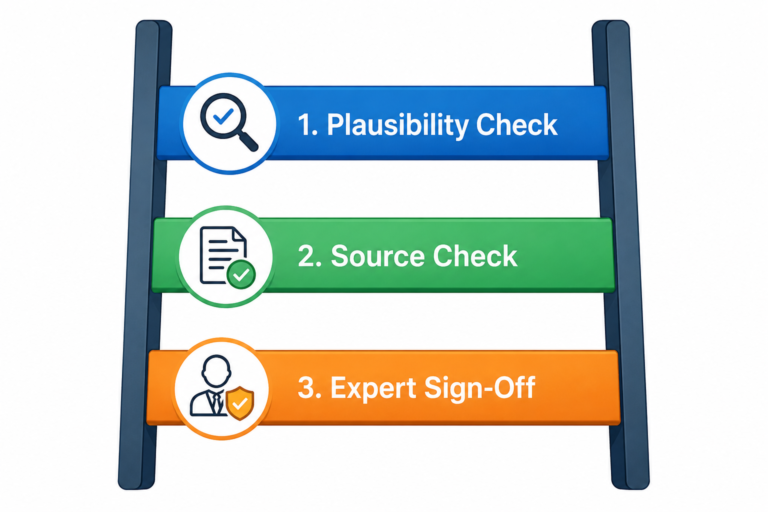
- Trusting unverified income claims at face value. Apply the same Verification Ladder from our verification guide to any “make money with AI” claim you read, including the ones in this article — check whether a number is traceable to something real before acting on it.
- Chasing AI combined with crypto or NFTs. Multiple sources single this specific combination out as disproportionately scam-heavy, with legitimate opportunities here requiring deep expertise in both fields and offering little realistic upside for a beginner compared to the other models on this list.
24. Long-Term Opportunities
The durable pattern across every credible source is specialization: generalist AI-assisted work is compressing in value as more people acquire the same baseline skill, while deep expertise in a specific industry or technical niche, combined with AI fluency, continues to command a premium. The gap between businesses that need AI implementation and people who can deliver it credibly is real and likely to persist for the next few years — but it rewards genuine specialization, not surface-level AI use, which is the same lesson this entire site has been making about individual productivity, just applied to business models instead.
Three specific long-term bets look more durable than the rest, based on the pattern across every model above: vertical specialization (an “AI consultant for X specific industry” rather than a generalist), implementation over ideas (businesses increasingly pay for someone who can actually deploy and maintain a system, not just recommend one), and trust-dependent services that stay adjacent to, rather than fully inside, what AI can automate — the accountant who uses AI to process invoices faster, not the accountant replaced by an invoice-processing tool with no one accountable behind it.
25. Frequently Asked Questions
Can you really make money with AI, or is it all hype? Both exist side by side. Real, modest-to-meaningful income is achievable through models like freelancing, chatbot services, and affiliate marketing — the hype is concentrated in unverified passive-income and outlier-earnings claims, particularly around faceless YouTube channels and AI content sites.
What’s the fastest way to make money with AI? Freelancing with AI, if you already have a marketable skill — it requires no new audience-building and can produce income within weeks, unlike audience-dependent models like newsletters or YouTube channels.
Is AI consulting a good business model in 2026? Only with real, demonstrable implementation experience. Generic AI consulting with no track record is one of the most crowded and lowest-credibility positions in the entire space.
Do I need to be technical to make money with AI? No — several models (freelancing, content, affiliate marketing, chatbot services on no-code platforms) require no coding. Technical skill mainly matters for the AI-powered SaaS model specifically.
What’s the biggest myth about making money with AI? That it’s passive. Every credible source reviewed for this guide contradicts that directly — AI reduces the effort required, it doesn’t eliminate it.
Should I trust income claims I see in other “make money with AI” content? Apply the Verification Ladder from our verification guide: check whether a claim is traceable to something real, treat precise-sounding but unsourced numbers with more suspicion, not less, and remember that outlier success stories are, by definition, not typical outcomes.