Will AI Take My Job? What the 2026 Data Actually Says
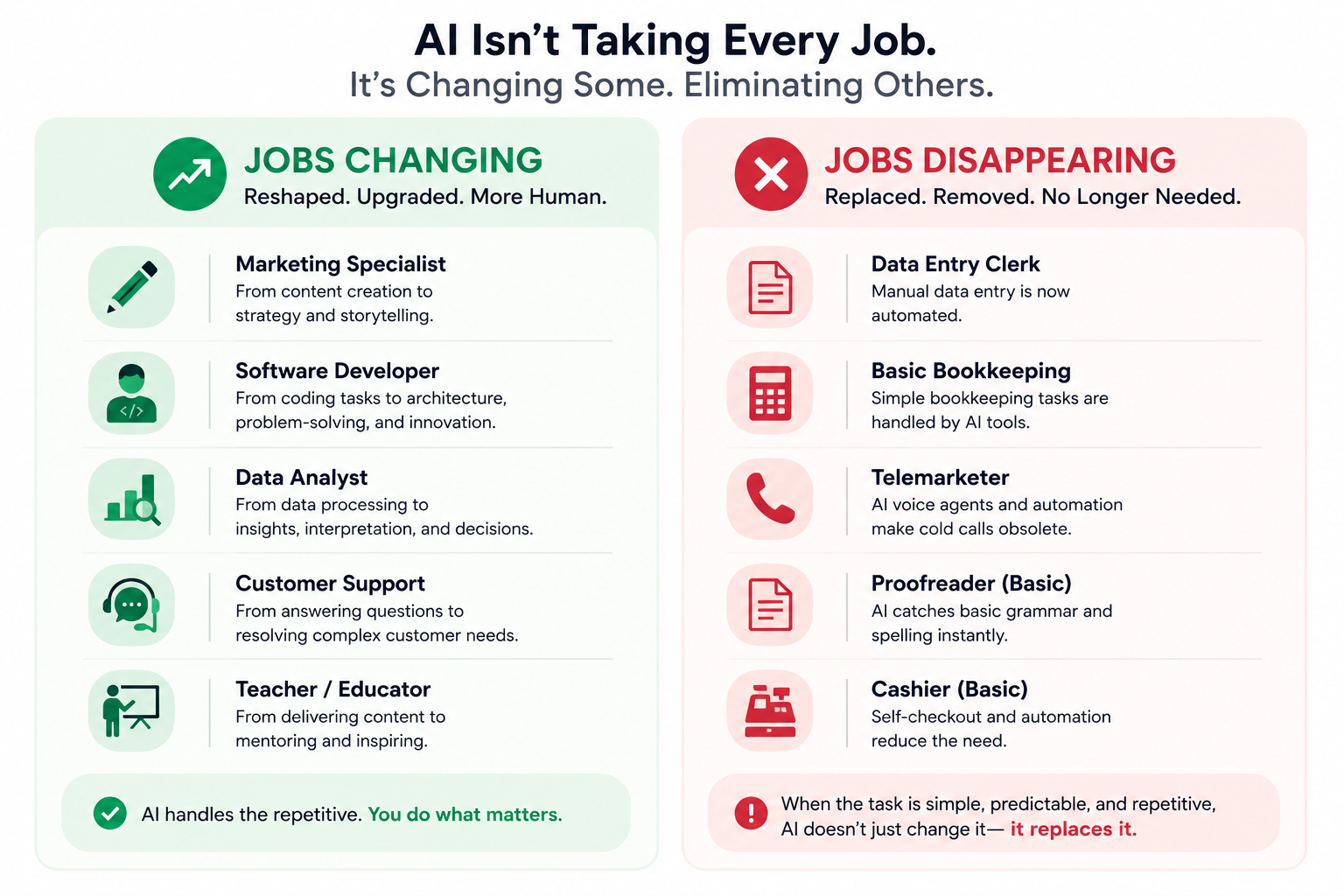
The honest answer is more specific than “yes” or “no”: AI is projected to displace roughly 92 million jobs globally between 2025 and 2030 — and create about 170 million new ones in the same window, a net gain of 78 million roles, according to the World Economic Forum’s Future of Jobs Report. That’s not a contradiction. It’s two different processes happening at once, and which one affects you personally depends far more on what you actually do day to day than on which industry you’re in.
What the Data Actually Shows
The World Economic Forum’s estimate is the most-cited large-scale projection, and it points toward net job growth, not collapse — but several other 2026 data points complicate a simple “don’t worry” takeaway. One widely cited HR survey found that roughly 37% of companies expect to have replaced some jobs with AI by the end of the year, and another found that about 89% of senior HR leaders believe AI will fundamentally reshape job descriptions and hiring within the same window. Meanwhile, Gartner has forecast that by this point, roughly half of organizations will use “AI-free” skills assessments during hiring, specifically to measure human-only strengths like critical thinking and emotional intelligence.
That last data point is worth sitting with: the more common AI becomes, the more employers are explicitly trying to verify what a candidate can do without it. This isn’t a contradiction of AI adoption — it’s a direct consequence of it.
The Genuine Expert Disagreement Worth Knowing About
This is a topic where credible people disagree, and it’s worth presenting both sides rather than picking one. Some prominent voices, including Turing Award winner Geoffrey Hinton, have warned that current AI systems are already capable of replacing many jobs and will expand well beyond obvious early candidates like call centers into a broad range of cognitive work. Other labor economists and platform analysts argue that macroeconomic trends and policy decisions remain bigger drivers of job loss than AI itself, and point out that previous major technology shifts typically produced a turbulent transition period followed by entirely new categories of work. The disagreement isn’t really about whether tasks get automated — most agree they will — it’s about how fast institutions and workers can adapt to absorb the change.
Where Jobs Are Actually Being Added
The net-growth number isn’t evenly distributed, and it isn’t abstract. In one recent year, the healthcare sector added over 640,000 AI-driven roles — spanning clinical decision support, medical imaging augmentation, and operational optimization. Financial services created roughly 470,000 AI-focused roles in the same period, concentrated in fraud detection, risk modeling, and algorithmic compliance. Design and manufacturing firms are following a similar pattern, using AI for planning, simulation, and operations. The through-line across all of these: new roles are appearing specifically around managing and overseeing AI systems — human-in-the-loop oversight, exactly the principle covered in our own AI Agents guide — not just roles that ignore AI entirely.
The Question That Actually Matters: Not “My Job” — “My Tasks”
Whether an entire job disappears is the wrong unit of analysis for most people. Jobs are bundles of dozens of individual tasks, and AI doesn’t uniformly touch all of them the same way. This is the same logic behind our Delegation Matrix from the beginner’s guide, applied one level up — from individual tasks to your entire role.
The Job Resilience Audit — Applying the Delegation Matrix to Your Career
Take your actual job description and break it into its real, individual tasks — not the polished bullet points, the actual things you do in a week. Sort each one using the same two questions from the Delegation Matrix:
| Quadrant | What it means for job security |
|---|---|
| Automate It (low judgment, low stakes) | These tasks are genuinely at risk of being absorbed by AI tools — not necessarily your job disappearing, but this specific slice of it shrinking |
| Brainstorm With It (high judgment, low stakes) | Durable — AI assists here, but doesn’t replace the judgment involved |
| Verify Twice (low judgment, high stakes) | Durable, but changing shape — these tasks increasingly involve overseeing an AI’s work rather than doing the task manually, which is a real skill shift, not elimination |
| Keep It Human | The most durable part of almost any job — trust, relationships, accountability, and judgment calls no employer wants an algorithm making alone |
How to read your own result: if a large share of your role’s tasks land in “Automate It,” that’s a genuine signal to build skill in adjacent Verify Twice or Keep It Human work now, not a signal that your job title itself is doomed on a specific timeline. Most real jobs are a mix of all four quadrants, and the practical move is shifting your own time toward the durable ones as the automatable ones shrink — not waiting to see what happens.
What This Means for Building a Resilient Career
Hiring trends increasingly reward two things at once, and they’re not in tension: demonstrable comfort working alongside AI and agents, and clear, AI-independent evidence of human judgment, communication, and collaboration skills — exactly the dual bar Gartner’s “AI-free skills test” trend is measuring for. Building the first half means genuine fluency with the tools and frameworks already covered across this site — prompt engineering, verification habits, and knowing when automation is and isn’t appropriate. Building the second half means deliberately protecting and developing the Keep It Human parts of your role — the judgment calls, the relationship management, the accountability — rather than letting them atrophy while you focus only on the AI-assisted parts.
Common Myths
- “AI will cause mass unemployment.” The most-cited large-scale data (WEF) actually projects net job growth, not collapse — though the transition is real and uneven.
- “AI adoption means nothing to worry about.” This ignores the genuine disruption within specific task categories, and dismisses credible expert warnings that deserve real consideration, not blanket dismissal.
- “Only certain industries need to worry.” Healthcare and finance — often assumed to be more insulated — are among the sectors adding the most AI-specific roles, meaning the change is arriving everywhere, just in different forms.
- “Learning to prompt an AI well is enough job security on its own.” Employers are explicitly testing for AI-independent skills specifically because AI fluency alone isn’t seen as sufficient — see the Gartner data above.
Frequently Asked Questions
Most credible large-scale data points to net job growth overall, but individual tasks within almost every job are genuinely changing — the more useful question is which of your specific tasks are most exposed, not whether your job title survives.
Healthcare and financial services have both added hundreds of thousands of AI-focused roles recently, concentrated in oversight, compliance, and operational roles — not just technical AI development positions.
No — this is a genuine, ongoing disagreement among credible sources. Some warn of broad, fast disruption; others argue other economic factors matter more and that past technology transitions eventually created new work. Both perspectives are worth taking seriously.
Build genuine fluency with AI tools and frameworks while deliberately protecting and developing the judgment, relationship, and accountability parts of your role that are hardest to automate — see the Job Resilience Audit above.
Because the two aren’t in tension — employers increasingly want both proof you can work effectively with AI and clear evidence of human judgment that doesn’t depend on it, precisely because AI fluency alone is now common enough not to be a differentiator on its own.